A biotech VC website needs to do more than look credible. The words on each page are what a founder, co-investor or prospective partner uses to decide whether to get in touch.
Yet even well-designed sites struggle here. The pages are in place, but the copy is vague, overly technical, or interchangeable with every other investment firm’s website.
In our earlier posts, we covered how to structure a biotech VC website and how to make it look credible. This time we’re focusing on the content itself: what to write on each page, and how to make the words work as hard as the design.
We’ll use Nucleus, our Squarespace template for biotech and life sciences investment firms, as the example, because its pages give each kind of content a clear home.

Start with the visitor, not the firm
Before you write a headline, decide who each page needs to reach.
A founder deciding whether to pitch you wants to know what you invest in and how you work. A co-investor wants evidence of your judgement. A prospective partner or hire wants to know who you are and what you stand for.
All three may land on the same site, but they don’t need the same information at the same moment. Give each page one primary reader and write to them. A page written for everyone usually persuades no one.
Write in plain language
Biotech is technical, but your website shouldn’t make readers work to understand what you do. Use clear headlines and plain opening sentences. Save the scientific detail for places where the reader expects it, like portfolio descriptions and perspective posts, and define a specialist term the first time you use it.
Be careful with words like “innovative,” “world-class” and “cutting-edge.” They sound impressive and say nothing. A specific fact does the same job better. Instead of “deep industry expertise,” name the experience: the companies your team has built, the scientific areas it understands, the challenges it has helped companies through.
The goal isn’t to simplify the science. It’s to make your thinking easy to follow.
Home page: a belief, a reason and one next step
Your home page should answer three questions fast: what do you invest in, why are you the right firm to do it, and where should the visitor go next?
The Nucleus demo opens with the headline “Science that changes what medicine can do,” followed by the line “Built by scientists who became investors.” Together they give a point of view and a reason to pay attention. A strong opening usually has the same two parts:
- Line one: your belief about where biotech or medicine is heading
- Line two: the reason your firm is the right one to act on it
For example, a fictional firm might write: “We back early-stage companies that turn new biology into medicines. Our partners have built and sold three biotech companies.” This is an illustration only. Your copy should reflect your real focus and experience.
Below the opening, add a few proof points you can verify, such as portfolio milestones, team experience or areas of expertise, and finish with one clear button like “See our portfolio.”
Portfolio page: one plain sentence per company
A portfolio page should show what each company is trying to achieve, not just who you’ve backed. Give every entry the same four details:
- Company name: the approved public name
- What it does: one plain sentence on the problem and the approach
- Area or stage: therapeutic area, modality or development stage
- Your role: how you invested or help, if you can substantiate it
The most common mistake is a description that could apply to any company. Here’s the difference, using a fictional company:
Before: “A pioneering biotechnology platform transforming the future of medicine.”
After: “Developing an oral treatment for a rare inflammatory bowel condition. Currently in Phase 1 trials.”
The second version tells a founder, co-investor or journalist exactly what the company does. Keep entries a consistent length so the page reads as a considered collection rather than a stack of promotional blurbs.
Always confirm that company names and details are approved for public use. For confidential or pre-announcement investments, follow your firm’s disclosure policy. If a company isn’t public yet, listing the area instead of the name is usually safer than leaving a gap.
About page: explain how you decide
The strongest About pages go beyond a founding story and a list of values. They show founders how you think about investing. Try answering three questions:
- What do you look for in a company or founding team?
- At what stage do you typically invest?
- How do you support companies after you invest?
The key distinction is between a value and a behaviour. “We are passionate about science” expresses enthusiasm. “We read the underlying data ourselves before every investment” describes something a founder can hold you to, as long as it’s accurate.
You don’t need to reveal confidential criteria or proprietary methods. You do need to give readers a credible sense of how you work.
People page: relevant experience first
For founders weighing an investor, the people behind the fund matter. Open each bio with the experience most relevant to that person’s role: companies built, scientific training, drug-development experience, board service or investing track record.
Aim for roughly 60 to 100 words per bio and use the same order for everyone so the partners read as a team. Check every credential, title and affiliation before you publish, and update the page when someone’s role changes. For readers who want more, Nucleus includes a bio post layout, so each person can have a longer page without crowding the main one.
News and insights: show how you think
A News & Insights page gives visitors a reason to return and a window into your thinking. Useful content includes:
- Investment perspectives: how you assess a scientific opportunity or a market
- Portfolio updates: milestones companies have approved for public release
- Firm news: hires, fund developments and partnerships
- Industry commentary: a considered view on developments in biotech
If you’re starting from scratch, three to six posts is enough to give the page substance. Treat that as a starting point, not a publishing quota. Add a date and an author to each one so readers can see who is speaking and how current it is. The Nucleus homepage includes a Latest Insights section, so new posts also appear on your front page.
Contact page: make the next step easy
Every page should lead somewhere, and for most visitors the destination is a conversation. Whatever your contact page looks like, it should answer three questions: who should a founder contact, what should they send, and what happens next?
A short, clear line does a lot. For example: “Send a brief overview of your company and the stage you’re at. We read every submission.” Only write what you can actually deliver, and never promise a response time you can’t keep.
Check the rules before you publish
A venture firm’s website is also a public statement about its business. Rules on how funds describe themselves, show performance and talk about fundraising vary by region and by the type of firm. Before you publish performance figures, fund details, testimonials or any wording that could read as an invitation to invest, check with your lawyer or compliance adviser.
The same care applies to scientific claims and portfolio announcements. Make sure everything is accurate, approved for release, and doesn’t overstate what the evidence supports.
A quick content checklist
Before you publish, review each page against these questions:
- Does each page have one main reader and one purpose?
- Does the home page explain your investment focus and what sets you apart?
- Can a non-specialist follow the main message without losing the science?
- Does every portfolio description say what the company actually does?
- Do the About page and bios show relevant experience rather than generic claims?
- Are all figures, credentials and company details accurate and approved?
- Does News & Insights offer useful, current material?
- Has the right person reviewed any legal, regulatory or confidential content?
- Does every page give the visitor a clear next step?
Give your content a clear home
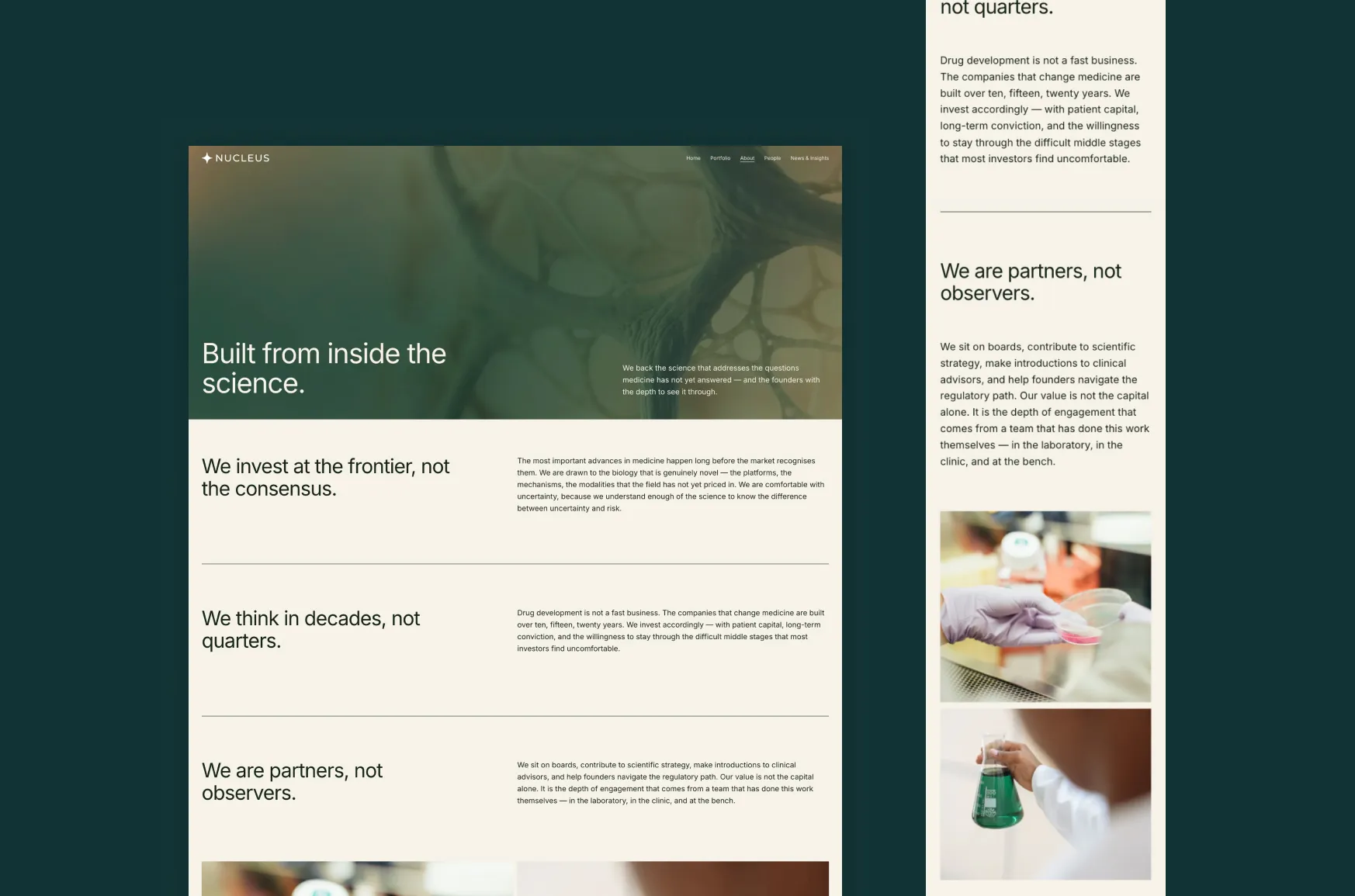
Once you know what each page needs to say, you need a structure that makes it easy to find. Nucleus gives you Home, Portfolio, About, People and News & Insights pages, plus layouts for individual bios and news articles, so you can spend your time on the words.
If you’re building or refreshing a biotech VC website, explore the Nucleus template → and see how its structure can support your content.
Prefer to have it done for you? Getting the messaging and structure right is often the hardest part of a VC website. If you’d rather work with someone who can shape the story, design the site and handle the build, we also take on custom branding and website projects. Talk to us about a custom build →